Supply chain planning software for high-consequence operations
Vista brings demand, supply, inventory, and scenario planning into one governed workflow — with the deterministic calculations, evidence, and audit control enterprise planning demands, on a far lighter footprint. Connect the systems you already have. No rip-and-replace, no multi-year suite transformation.
What Vista plans
Vista covers the planning work your team already does — with the calculations, risk, and evidence made explicit and governed at every step.
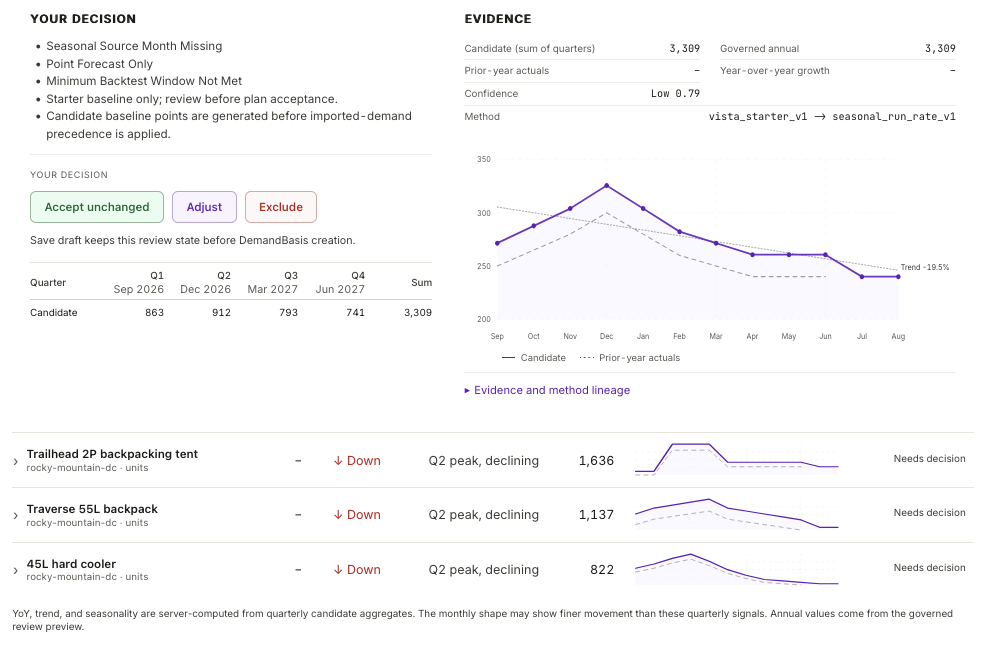
Understand and govern the demand basis before it enters the plan.
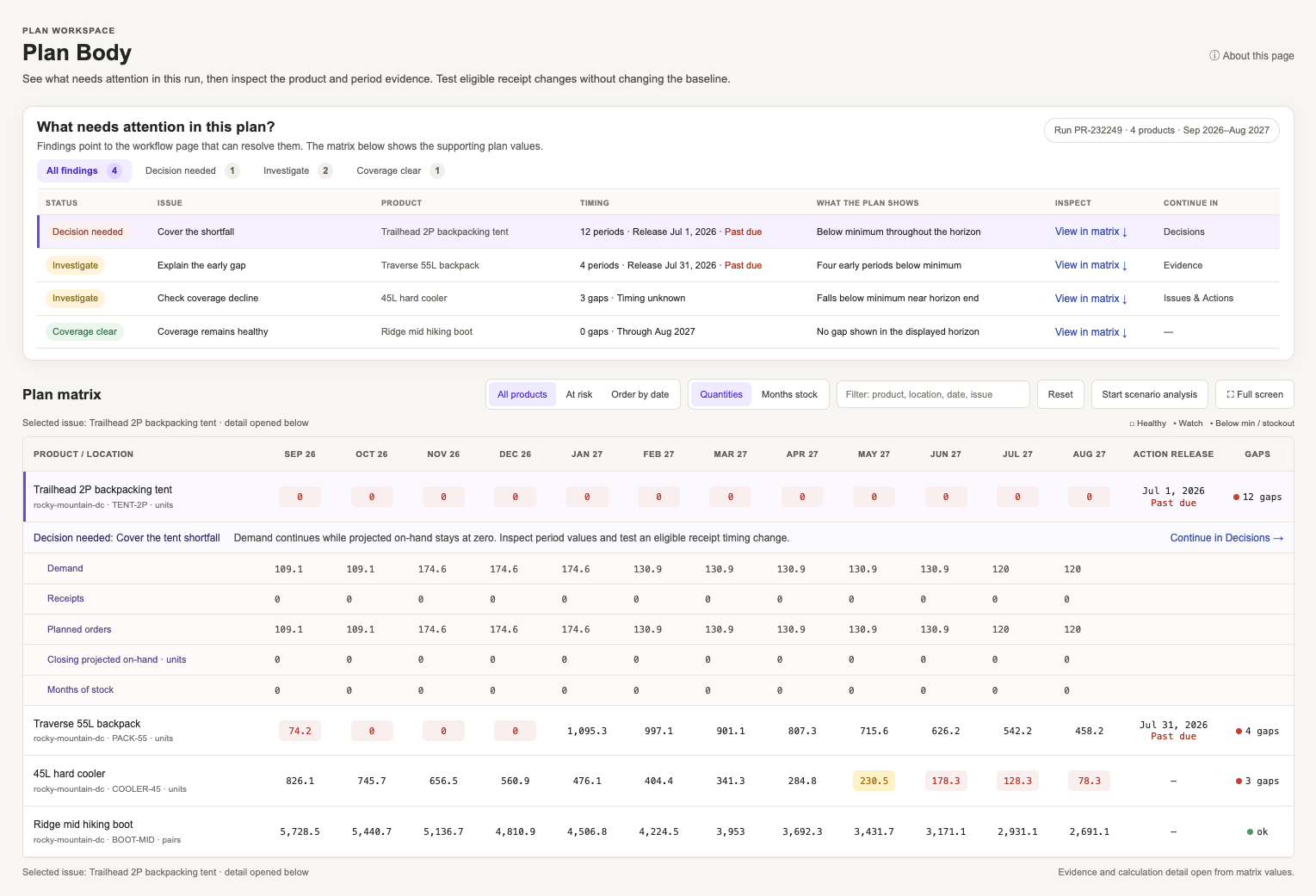
Balance future demand against usable inventory, pipeline, lead times, policies, and existing commitments.
Surface stockout, excess, expiry, and coverage risk over time.
Compare plan runs and feasible responses before you commit.
Review recommendations, record approvals or overrides, and preserve the evidence behind the accepted action.
Vista opens a Planning Record for each planning cycle — a durable, versioned source of truth that captures ingested sources, computation runs, decision records, evidence bundles, and reviewer actions. Bring in the latest data and rerun against the same record. The record carries the provenance forward.
Upload flat files or connect directly to source systems — either way, map fields once and the structure carries forward. Every source that enters the record is versioned, profiled, and traceable to the planning cycle it came from.
Bounded agents run analytical workflows against the record. Deterministic engines compute supply requirements, risk signals, and scenario comparisons — without AI shortcutting the math.
Humans review Planning Decision Records, inspect Evidence Bundles, and accept or hold every output before it enters the planning record or is distributed. The reviewer's action is permanent.
One record. Auditable from source to decision.
Impact
Vista is built for high-consequence supply chains — the ones where a planning mistake costs lives, not just margin. Proven first in health and humanitarian work: global health commodities, hospital pharmacy, vaccines and blood, humanitarian and food assistance, and nutrition. What changes for these teams: one-off spreadsheet analysis becomes a repeatable planning rhythm in one governed workflow, with consistent quality, transparent reasoning, and faster cycles.
One encoded method
Consistent quality across planners
Vista encodes the expert planning method and runs it the same for every planner, every cycle. Quality stops depending on who is at the keyboard.
Show your work
Transparent reasoning
Every number traces back to its inputs and the computation behind it. When a plan is questioned, the reasoning is visible, not buried in a spreadsheet.
Reusable structure
Faster planning cycles
Map the source data once, then reuse the structure each cycle. Planners spend less time rebuilding spreadsheets and more time on the planning question.
Purpose-built for agents and humans
Most planning tools were built for people, then added AI on top. Vista was built for both. Agents work on the same platform as people, with their own accounts, permissions, and guardrails. The Planning Record, Planning Decision Record, and Evidence Bundle, the same objects your team relies on, are the shared state and audit trail agents operate within. Agents do real planning work, they cannot invent a number outside the engine any more than a person can, and every action they take is recorded. Where other platforms ask you to trust their AI, Vista holds its agents to the same verifiable standard as people, so you never have to take the AI's word for anything.
Agents ingest data, run analytical workflows, and write structured outputs to the Planning Record. Every step is logged.
The Planning Decision Record defines what agents can do and in what sequence. The authority model is enforced, not assumed.
The organization sets what agents can act on and what needs a human decision. Reviewers see the full evidence trail before they accept, adjust, or send back.
In high-consequence supply chains, the question isn't whether to use agents. It's whether your platform was built to govern them.
Vista coordinates source ingestion, deterministic computation grounded in the physics of supply planning, bounded agent work, and structured human review into a single planning cycle. Map the data once. Before every workflow runs, Vista checks whether the inputs are complete enough to trust. Then run the analysis, compare scenarios, inspect the evidence, and record every decision with full provenance.
Ingestion and mapping
Source export
Canonical fields
Map the first workflow in a focused session. Rerun future cycles from the same saved structure.
Upload flat files or connect directly to a source system, review the detected fields, and map them into Vista's planning workflow. Save the mapping once, then reuse it whenever fresh data arrives.
Data readiness gate
Before any analysis runs, Vista profiles the source, normalizes fields, checks required inputs, and flags whether the data is complete, partial, or insufficient. When something needs attention, Vista helps your team resolve mapping questions, missing fields, or quality issues before the workflow proceeds.
Analytical workflows
Launching with four core planning workflows, with more on the way.
Can we trust this file enough to use it?
Profile sources, review mappings, check sufficiency, and flag data quality exceptions before analysis begins.
What demand signal should we plan from?
Review demand trends, generate forecast drafts, surface exceptions, and account for stockout-adjusted demand signals.
How much supply is required over the planning horizon?
Compare demand, stock on hand, pipeline, lead time, and scenarios to draft supply requirements.
Where are the stock, overstock, expiry, or policy risks?
Surface stockout risk, days out of stock, overstock exposure, expiry exposure, and min/max policy issues.
Once the data passes the readiness gate, each analytical workflow uses the saved mapping to run the planning job, show what passed, flag what needs review, and produce a verifiable brief your team can defend.
PlanDiff comparison
Current Run
14
Facilities below target DOS under the current policy.
Proposed Scenario
5
Facilities below target DOS after a policy update and securement plan.
Vista generates a PlanDiff between any two runs, scenarios, or planning cycles. See exactly what shifted in the demand signal, what changed in supply requirements, which facilities moved between risk categories, and what the source of the change was. Every comparison is traceable — not just the delta, but why the delta happened.
Evidence and reliability
Every analytical output is packaged with an Evidence Bundle: the source data, mapping version, computation run, checks applied, exceptions flagged, and the assumptions that still need human judgment. A Reliability Score measures input completeness, computation confidence, and source consistency. Your team sees how much to trust the output before they act on it.
Planning Decision Records
12 facilities are at risk, including 3 critical sites under 7 days of supply.
Reviewer status: Accepted after ETA assumption was confirmed for the northern region.
Export the PDR, send the table set, or share a versioned link with stakeholders. Audit trail included.
Every significant planning question opens a Planning Decision Record. Vista packages the analytical output, the evidence bundle, the reliability score, and the reviewer's decision into a single durable record that travels with the planning cycle. Accept, hold, or request additional input — the PDR captures the action, the evidence that preceded it, and the version of the plan at that moment.
Vista works with the planning inputs your team already has, whether that's flat file exports from existing systems or direct connections to platforms like DHIS2, EHRs like Epic and Cerner, or ERP and WMS systems like SAP and Oracle. It profiles the source, suggests mappings, normalizes values, and helps your team turn varied inputs into a reusable planning model.
Start with flat files you already have, like pharmacy exports, Excel workbooks, distributor trackers, and warehouse tables, or connect directly to source systems. Vista works with both.
Vista reads the structure first: sheets, headers, sample rows, product labels, locations, dates, units, and quantities.
Vista suggests how each source field connects to the planning model, then saves the mapping as a reusable template.
Governance by Architecture
Vista's authority model is not a policy or a setting. It is structural. The platform enforces the boundary between what agents can prepare and what the organization's guardrails route to a person, so planning decisions in high-consequence supply chains carry the evidence and review they require.
Demand signals, supply requirements, and stock risk are computed deterministically, grounded in the physics of supply planning. Same inputs, same plan. No AI shortcutting the math. The deterministic layer is the spine. Agents and people both work against the same computation, not around it, and no one can invent a number outside it.
Agents prepare, draft, and flag within defined authority boundaries. They cannot own numeric truth, accept planning decisions, or bypass the evidence layer. Agent-prepared output is marked as agent output. It cannot be confused with human-accepted output, and the distinction is enforced by the platform, not convention.
Every recommendation is packaged with its Evidence Bundle: source data, computation run, checks applied, flags raised, and exclusions. A Reliability Score measures input completeness, computation confidence, and source consistency — so your team sees how much to trust the output before acting on it. This verification methodology is covered by three provisional patent applications.

Why "Ventoux"
Pronounced von-too.
Mont Ventoux is long, exposed, and unforgiving. Conditions shift quickly. Small mistakes compound. The teams that succeed are the ones that read the terrain early and adjust before the climb turns against them.
High-consequence supply chains work the same way.
Vista helps teams spot the early signals that can change supply outcomes: fragmented inputs, stock risk, delayed shipments, policy gaps, and assumptions that need review. The goal is simple: give planners a clearer view of the terrain so they can move with confidence.
We named the company Ventoux for this work: helping teams read uncertainty early, prepare intelligently, and navigate supply chain risk with confidence.